

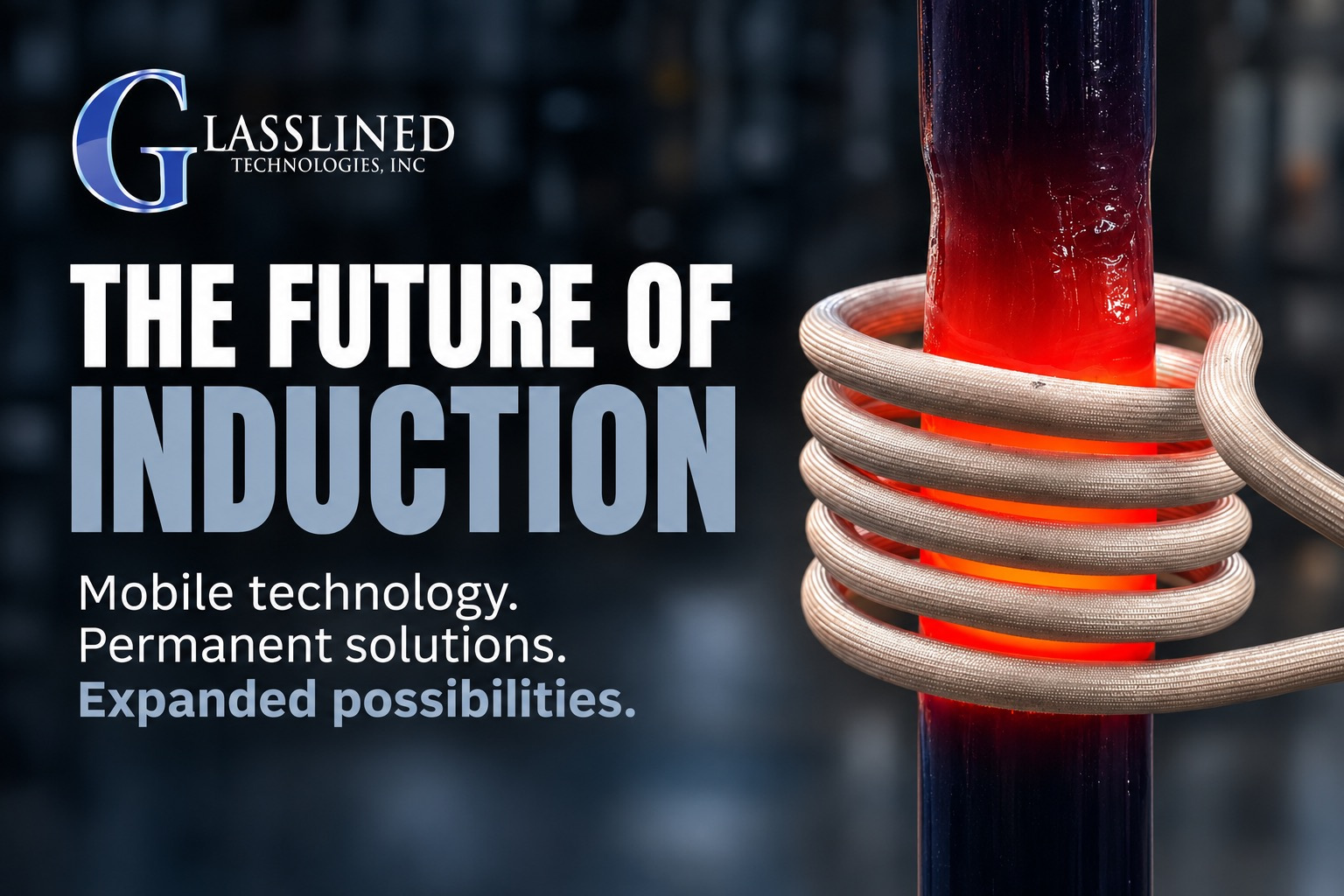
For decades, applying or restoring glass coatings to steel has largely depended on one major limitation: the furnace.
Traditional vitreous enamel requires extremely high firing temperatures, historically tying glass-lined equipment manufacturing and major restoration work to specialized facilities with large industrial furnaces.
Mobile induction technology is beginning to challenge that model.
By using localized electromagnetic induction to heat the steel substrate, glass and ceramic materials can potentially be fused to metal exactly where the repair or coating is needed, without heating an entire structure inside a stationary furnace.
For Glasslined Technologies (GTI), that capability is already changing how damaged glass-lined processing equipment can be repaired, including reactors and components used in Pfaudler, De Dietrich, and Thale glass-lined processing systems.
The next question is much bigger:
Where can induction take us next?
A Growing Market and a Growing Need for Glass-Lined Equipment Repair
The opportunity begins with the industry GTI already knows.
The U.S. glass-lined processing equipment market is currently estimated at approximately $310 million and is projected to reach approximately $506.4 million by 2033.
Globally, the glass-lined equipment market is projected to grow from approximately $2.6 billion in 2026 to $4.6 billion by 2033, representing a compound annual growth rate of roughly 8.4–8.5%.
Several forces are contributing to that growth.
Pharmaceutical manufacturers are increasingly focused on domestic production of active pharmaceutical ingredients and biologics. Specialty chemical manufacturing continues to require equipment capable of handling aggressive process environments. At the same time, requirements surrounding product purity, cross-contamination, and cleanability continue to influence material selection.
But growing demand for glass-lined equipment also creates growing demand for maintaining what is already installed.
Facilities operating glass-lined reactors manufactured by companies such as Pfaudler, De Dietrich, and Thale depend on the integrity of these systems to maintain production efficiency and process reliability.
Reactors don't consist solely of the vessel shell. Agitators, shafts, hubs, baffles, piping, flush valves, manway covers, mechanical seals, and other components operate in demanding environments and eventually require repair or replacement.
For facilities maintaining Pfaudler, De Dietrich, or Thale glass-lined equipment, finding effective repair solutions can be essential to minimizing downtime and extending equipment service life.
And those replacement costs are becoming significant.
When Glass-Lined Equipment Repair Changes the Economics
Consider a common 4,000-gallon agitator shaft.
A new shaft without a hub can cost approximately $40,000, and the required component may not be sitting on a shelf waiting to ship.
The alternative can be dramatically different.
On a recent project in Cap-Chat, Quebec, GTI transported its Mobile Induction System approximately 1,700 miles to the jobsite. The induction equipment, labor, and associated expenses totaled approximately $70,000, and the repair was completed onsite in two days.
Instead of automatically replacing a major component or transporting equipment back to a manufacturing facility, mobile induction allows the repair process to come to the equipment.
This approach can be particularly valuable for facilities operating large glass-lined reactors, including Pfaudler, De Dietrich, and Thale processing equipment, where component replacement may involve substantial costs and extended lead times.
That distinction becomes increasingly important as component prices, material costs, and lead times rise.
Tantalum, traditionally used in many glass-lined equipment repairs, has also experienced significant cost pressure. GTI has seen tantalum pricing increase approximately 150%, adding another incentive to evaluate permanent repair technologies that can reduce dependence on costly replacement materials.
GTI also provides custom tantalum repair solutions designed for use in Pfaudler, De Dietrich, and Thale glass-lined processing equipment, offering facilities additional options when evaluating equipment maintenance and repair needs.
The future of maintenance may therefore be less about replacing damaged components and more about restoring their functional surfaces.
From Mobile Glass-Lined Reactor Repair to Mobile Manufacturing Technology
This is where induction becomes particularly interesting.
GTI's technology uses induction to generate highly controlled, localized heat in the underlying metal substrate. That heat can be used to fuse specialized glass material directly to a damaged area.
Rather than heating an entire vessel or component, energy is concentrated where it is needed.
For operators of Pfaudler, De Dietrich, Thale, and other glass-lined reactor systems, this technology represents an alternative approach to addressing certain types of glass damage without relying exclusively on traditional furnace-based restoration methods.
Developments in glass formulations could expand that capability further. New formulations capable of producing vitreous enamel with firing cycles around 750°F may create opportunities that were previously impractical for field-applied glass technology.
That raises the possibility of moving beyond repairing traditional glass-lined reactors.
Instead of asking:
"How can induction improve glass-lined equipment repair?"
The industry can begin asking:
"What other steel surfaces could benefit from an induction-fired inorganic coating?"
A Potential Alternative to PFAS-Dependent Coatings
One of the most compelling areas for further research is the replacement of certain organic or fluoropolymer-based coatings with inorganic glass or ceramic systems.
Materials such as PTFE and PVDF have valuable performance characteristics and are widely used across industry. At the same time, increasing regulatory and environmental attention surrounding PFAS is creating demand for alternative technologies in applications where fluorinated materials have traditionally been used.
An induction-fired glass or ceramic coating presents a fundamentally different approach.
Rather than applying an organic coating that cures or dries onto steel, induction could potentially allow an inorganic material to be fused directly to the metal substrate onsite.
For appropriate applications, the potential characteristics are compelling:
High corrosion resistance
Chemical inertness
No chemical leaching from a fully inorganic glass surface
High-temperature capability
Long service life
Low-friction surfaces
Reduced dependence on organic coating systems
Not every application will be technically suitable, and each would require significant testing and qualification.
But the potential market extends far beyond traditional processing equipment.
Water Infrastructure
One of the most intriguing possibilities is municipal water storage.
The United States has tens of thousands of steel water towers and storage tanks, many of which were constructed decades ago and require periodic interior coating maintenance to control corrosion.
Traditionally, maintaining these structures can involve removing deteriorated coatings, preparing the steel, and applying a new organic coating system.
Mobile induction creates another possibility worth investigating: field-applied glass or ceramic coatings for localized repairs, welded seams, or potentially larger areas of steel infrastructure.
For drinking-water applications, any new system would need to meet applicable potable-water standards and undergo extensive testing and certification.
But if those hurdles can be cleared, an inert inorganic surface could offer an entirely different approach to long-term corrosion protection.
Maritime and Defense Applications
The same concept could potentially extend into some of the harshest corrosion environments in the world.
Ships, ballast tanks, fuel-storage systems, piping, and other maritime structures experience constant exposure to moisture, saltwater, and aggressive operating environments.
Corrosion prevention represents an enormous ongoing maintenance expense for military and commercial fleets alike.
Potential future applications for mobile induction-fired coatings could include:
Ship and ballast tank surfaces. Localized glass or ceramic coatings could potentially provide corrosion protection without requiring the repeated application of certain conventional organic coatings.
Fuel and water infrastructure. Storage tanks and piping located at military installations or forward operating locations could potentially be coated or repaired onsite.
Localized ship repair. Mobile technology could potentially allow selected corrosion-resistant surfaces to be restored without removing the entire structure from service for conventional furnace processing.
For defense applications in particular, reducing corrosion isn't simply a maintenance issue. It can affect equipment availability, lifecycle costs, and operational readiness.
Bridges, Structural Steel, and Industrial Infrastructure
The concept becomes even broader when induction is viewed as a mobile surface-engineering platform rather than simply a reactor-repair technology.
Future research could explore applications involving:
Pipelines
Structural steel
Bridges
Commercial ships
Marine buoys
Industrial support structures
Steel exposed to corrosive plant vapors
Storage tanks
Water infrastructure
Each presents different challenges involving substrate thickness, geometry, thermal expansion, coating formulation, adhesion, field conditions, and inspection requirements.
These are potential applications, not established commercial uses of GTI's current technology.
But that distinction is precisely what makes the opportunity exciting.
The Furnace No Longer Has to Define the Possibilities
Industrial glass coating has traditionally been constrained by the size of the furnace, the dimensions of the component, and the ability to transport that component to a specialized facility.
Mobile induction begins to remove that constraint.
GTI has already demonstrated that induction equipment can travel to a customer facility and perform permanent glass-lined equipment repairs onsite.
For facilities operating Pfaudler, De Dietrich, Thale, and other glass-lined processing equipment, onsite repair technology offers a way to evaluate restoration options while potentially reducing the logistical challenges associated with conventional repair methods.
The next generation of development is about determining how far that fundamental capability can extend.
Could induction-fired glass provide new solutions for water infrastructure?
Could inorganic ceramic systems reduce dependence on certain organic coatings?
Could steel structures be given highly corrosion-resistant surfaces without ever entering a furnace?
Could ships, pipelines, tanks, or structural components eventually be repaired or coated where they stand?
Those questions require engineering, material development, testing, and certification before they become commercial solutions.
But the underlying technology changes what is possible.
The Future Is Mobile
The growth of pharmaceutical, chemical, and advanced manufacturing is increasing demand for glass-lined processing equipment at the same time that plants are looking for ways to extend the service life of existing assets.
Mobile induction addresses both sides of that equation.
Today, Glasslined Technologies brings permanent glass repair technology directly to damaged process equipment, helping facilities explore alternatives to traditional repair and replacement methods.
Whether maintaining Pfaudler, De Dietrich, Thale, or other glass-lined processing systems, equipment owners increasingly need repair solutions that prioritize reliability, efficiency, and long-term performance.
Tomorrow, the potential of induction technology could reach much further.
The future of induction isn't simply repairing glass-lined equipment differently. It may be applying high-performance inorganic surfaces in places where glass previously wasn't practical at all.
And that is the opportunity Glasslined Technologies is working to explore.